The history of the Pic Blanc…
From the first ascent to the influx of thousands of skiers every winter… It was in the 1870s that Joseph Bayle, parish priest of the village of Oz 3300, took part in the first expeditions to the peaks of the Oisans. The highest peak in the Grandes Rousses massif is, in fact, named after him: the Pic Bayle. It was this seasoned mountaineer who named the summit ‘Pic du Lac Blanc’, more commonly known today as ‘Pic Blanc’. In 1963, the cable car providing access to the summit was built; today, it enables many skiers and hikers to reach the summit of the Pic Blanc.
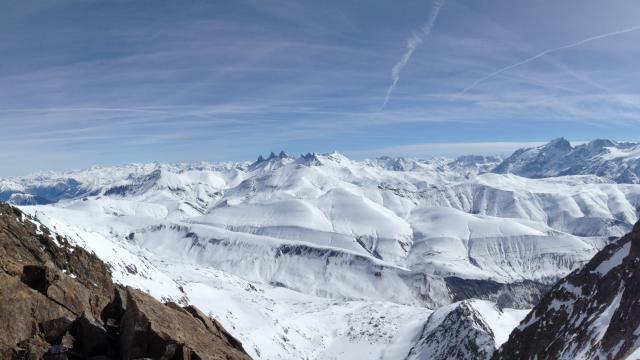
Pic Blanc, Alpe d'Huez, Grand Domaine, view of the Aiguilles d'Arves

Pic Blanc, Alpe d’Huez, Grand Domaine

Pic Blanc, Alpe d’Huez, Grand Domaine
|
Highest peak in the Alpe d’Huez Grand Domaine Ski Area
Mont Blanc, La Meije, Les Grandes Jorasses… mountains as far as the eye can see! Straddling the villages of Oz 3300 and Le Freney d’Oisans, the Pic Blanc is one of the highest peaks in the Grandes Rousses massif, alongside the Pic Bayle (3,465 m) and the Pic de l’Étendard (3,464 m). The view is exceptional on a clear day! From the Pic Blanc, you can admire the surrounding mountain ranges; a map marker will help you identify each of the peaks: Pic Bayle, Grande Casse de Pralognan, Grande Motte de Tignes, Grand Paradis in Italy, the Vanoise glaciers, the peaks of the Maurienne, as well as La Meije, the Barre des Écrins and the Mont-de-Lans glacier…
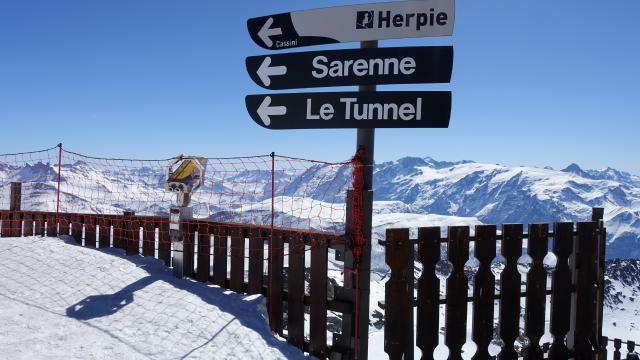
The starting point for the legendary slopes: La Sarenne and Le Tunnel
At an altitude of 3,330 metres, Le Pic Blanc is the highest peak in the ski area. But it is also the starting point for the most legendary runs: La Sarenne, Europe’s longest black run (a 16km descent!), and Le Tunnel, a dizzying run that passes through a tunnel carved into the rock.
Pic Blanc Summit, Alpe d’Huez Grand Domaine
|

Pic Blanc, Alpe d’Huez 4@fabien Gruas No Limit Shooting
|